
The Green Death
Today, parakeets are a common sight in public parks. But in 1930 the birds sparked a worldwide panic when it was discovered their faeces contained a deadly bacterium.

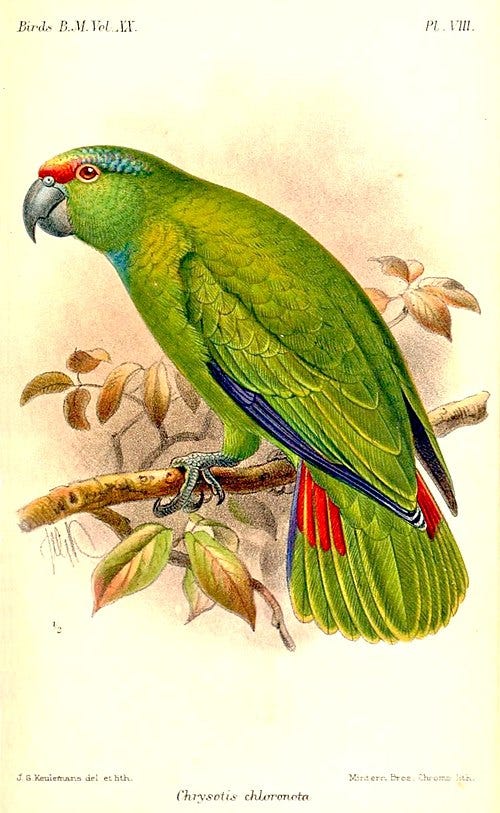
With their lime-green foliage and high-pitched screeching, it’s hard to avoid parakeets these days. In Kensington Gardens and other London parks, they are nearly as ubiquitous as pigeons. No one knows when these raucuous birds, which are native to the Himalayas, first arrived in the capital but whenever I see one I am reminded of the great parrot fever pandemic of 1930.
Never heard of it? You are not alone. Unlike other pandemics of the twentieth and twenty-first centuries, the parrot fever pandemic scarcely warrants a mention in most medical textbooks but in the 1930s parakeets sparked widespread alarm when it was discovered their faeces harboured a deadly bacterium - psittacosis. When their faeces became dry and crumbly, it only took a flap of the birds’ wings to send thousands of dessicated psittacosis particles into the atmosphere. Housewives, for whom the pets served as aural companions in the days before FM radio, were at particular risk and soon deaths from “atypical pneumonias’ were being reported across the United States.
Below, I reprint an extract from chapter three of my book, The Pandemic Century, describing an early case in Annapolis, Maryland, and the near-simultaneous outbreaks that followed. Although a total of just 33 psittacosis infections were recorded in the U.S. and 800 worldwide, parrot fever had a mortality rate of 15 percent, making it the perfect subject for the yellow press. Indeed, researching this chapter involved many hours spooling through microfiche in the periodicals room at the Library of Congress. Hearst Newspapers, which specialised in lurid tales to terrify housewives, was a particularly rich source. Other sources were back issues of Public Health Reports and Paul de Kruif’s Men Against Death.
Please note: the first part of the extract is free to read.
ON JANUARY 6, 1930 Dr. Willis P. Martin paid an urgent house call on a family in Annapolis, Maryland. Lillian, her daughter Edith, and Edith’s husband Lee Kalmey, the owner of a local auto repair shop, had begun to feel feverish shortly after Christmas, and all three were now deathly ill. At first, they attributed their symptoms to influenza and the depressive effects of the recent stock market crash, which had hit Kalmey’s business as hard as any, but in the first week of the new year their condition had taken a decided turn for the worse. To the chills and generalized aches and pains typical of influenza was now added an irritable dry cough, accompanied by constipation and exhaustion that alternated with headaches and insomnia. For large parts of the day, Lillian, Edith, and Lee lay somnolent as logs, the silence broken only by their intermittent mutterings. By contrast, when awake they would be restless and prone to fits of violent excitement. The most worrying symptom of all, however, was the rattling sound coming from deep within their lungs.
Dr. Martin suspected pneumonia, possibly mixed with typhoid fever. However, Lillian’s husband, who had eaten the same meals as the rest of the family, was perfectly well, which tended to rule out a food-borne illness. The only other member of the household who had been sick was a parrot that Lillian’s husband had purchased from a pet store in Baltimore and which Edith and Lee had kept at their home in the run-up to the Yuletide festivities so as to present the bird to Lillian as a surprise on Christmas Day. Unfortunately, by Christmas Eve the parrot’s plumage had grown ruffled and dirty and the creature was showing signs of listlessness. Come Christmas Day the parrot was dead.
Dr. Martin was baffled by the family’s symptoms and shared his bewilderment with his wife. At first, Mrs. Martin was similarly puzzled. Then Dr. Martin mentioned the dead parrot. It might be a coincidence, she said, but the previous Sunday she had been reading about an outbreak of “parrot fever” in a theatrical troupe in Buenos Aires. According to the newspaper report, the disease was being blamed for the death of two members of the company, who, in common with other members of the cast, had been required to interact with a live parrot on stage. That bird was now dead and pet owners throughout Argentina were being warned to report sickly psittacines—birds in the parrot family—to the authorities.
It sounded unlikely, ridiculous even, but Martin was not the type to take a chance. Instead, he sent a telegram to the Public Health Service in Washington, DC:
request information regarding diagnosis parrot fever…what information available regarding prevention spread of parrot fever…can you place supply parrot fever serum our disposal immediately. wire reply.
Martin was not the only doctor puzzled by the sudden appearance of mysterious pneumonias accompanied by typhoid-like symptoms in the United States that winter. By now similar telegrams were arriving at the PHS from Baltimore and New York, and health officials in Ohio and California were fielding similar requests for information. Like Martin’s telegram, these communications ended up on the desk of Surgeon General Hugh S. Cumming, who passed them on to his subordinate, Dr. George W. McCoy, the director of PHS’ Hygienic Laboratory. A veteran of the bubonic plague investigations in San Francisco, McCoy was renowned for discovering tularemia, dubbed the “first American disease” because the bacterium was first identified in McCoy’s lab in California, and was then the most celebrated bacteriologist in America.1 If anyone could solve the outbreak, Cumming figured, it was McCoy. But when McCoy read Martin’s telegram he could not help smiling. Parrot fever? It sounded like the sort of diagnosis you might encounter in the medical columns of the yellow press or a joke in the funny pages. Certainly, McCoy had never heard of parrot fever. But then McCoy was a busy man—America was in the grip of an influenza epidemic, a recrudescence, it was feared, of the Spanish flu, and he and his deputy, Charlie Armstrong, were working day and night on a serum for postvaccinal encephalitis, a “sleeping sickness” that affected some individuals who’d received the smallpox vaccine. Nevertheless, McCoy thought it best to check with his colleague.
“Armstrong, what do you know about parrot fever,” McCoy demanded.
“What do I know about it? I don’t know a thing about it,” Armstrong admitted.
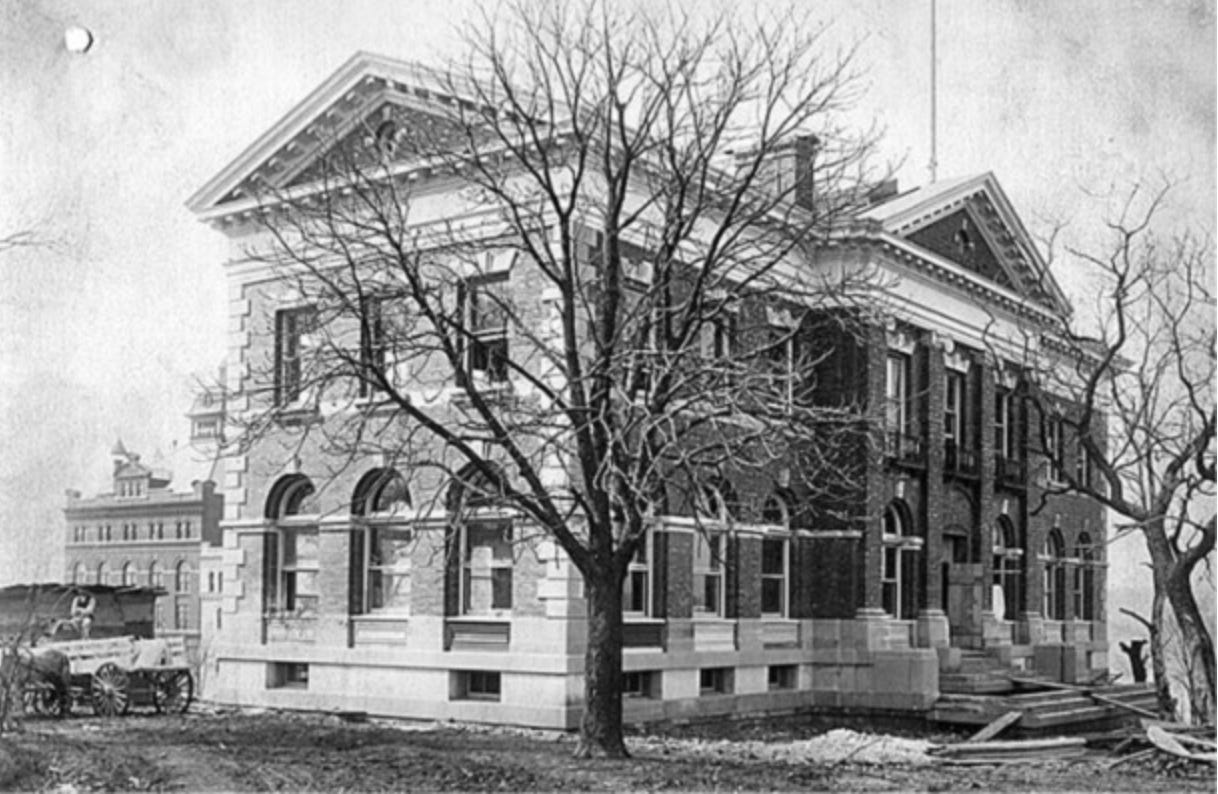
Within days, however, McCoy and Armstrong would come to rue their ignorance as one by one laboratory workers tasked with investigating whether parrots were implicated in the outbreaks seen in Annapolis and elsewhere, fell ill. Indeed, by February Armstrong and several other personnel at the “Hygienic,” as the ramshackle red-brick laboratory overlooking the Potomac was known, had been removed to the nearby U.S. Naval Hospital. By the time the outbreak concluded in March, Armstrong’s longtime assistant, Henry “Shorty” Anderson, was dead. In the end, it fell to McCoy to conduct the critical passage experiments on parrots in the basement of the Hygienic in an attempt to isolate the “virus” of psittacosis and develop a serum. But the tests were inconclusive and in the end McCoy had been forced to chloroform the birds and fumigate the Hygienic from top to bottom to prevent the putative virus from escaping the building. As the science writer Paul de Kruif put it in his book Men Against Death, McCoy “never smiled nor even muttered” as he performed this grim task, “but just killed and killed and at the end of it swashed out every last cage with creosol, and gave all the dead bodies of those assorted unhappy experimental creatures a decent and thorough burning in the laboratory incinerator.
Keep reading with a 7-day free trial
Subscribe to Going Viral to keep reading this post and get 7 days of free access to the full post archives.